The problem: la
bels that judge instead of inform
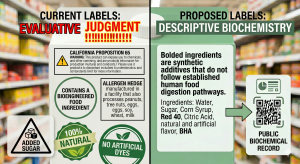
Current food labeling leans heavily on evaluative language. “No artificial colors.” “Natural.” Various state-level warnings about ingredients “not recommended for human consumption.” These terms carry implicit moral weight without telling consumers anything concrete about how a substance interacts with their biology. The result is predictable: legal challenges, consumer fatigue, and labels that are louder than they are informative.
Texas SB 25 is the sharpest recent example. It required foods with any of 44 specified ingredients to display “WARNING: This product contains an ingredient that is not recommended for human consumption by the appropriate authority in Australia, Canada, the European Union, or the United Kingdom.” In February 2026, a federal court granted a preliminary injunction on First Amendment grounds, finding the compelled statement failed even intermediate scrutiny — the state could have spoken through its own public information campaign rather than forcing manufacturers to carry the message. California’s Proposition 65 has the opposite problem: its cancer/birth-defects language now appears on coffee, french fries, parking garages, and hardware-store receipts, diluting the signal so thoroughly that most shoppers have learned to ignore it.
What’s missing in both cases isn’t volume — it’s specificity. A label that simply describes what happens to the molecule inside the human body can inform without alarming, and can survive both legal scrutiny and consumer attention in ways that evaluative warnings cannot.
The body as a digestion machine
Human digestion is not a black box. The upper gastrointestinal tract uses a defined set of enzymes — amylase, lipase, proteases, sucrase, esterases, and others — to break starches, fats, proteins, simple sugars, and many small molecules into absorbable units. What reaches the colon largely intact is handled by the gut microbiota, which supplies additional enzymes that ferment fibers, polyphenols, and other compounds our own cells can’t process. This combined system produces a characteristic range of byproducts: CO₂, water, short-chain fatty acids, simple organic acids, and recognizable nutrients.
A substance fits into food when it enters this system and exits as those familiar byproducts. A substance does not fit when human enzymes fail to recognize it and gut bacteria either leave it intact or cleave it into metabolites outside that familiar range — aromatic amines from azo dyes, for example. That mismatch is a verifiable biochemical property, not an opinion.
This is the clean descriptive line, and it’s where a better label should live.
The proposal: a single header, selective bolding
Place one statement near the ingredients list, and bold only the ingredients that trigger it.
Three candidate headers, from most precise to most concise:
Ingredients in bold are synthetic additives whose metabolism differs from the pathways used for natural food components.
Bolded ingredients are synthetic compounds not processed through the metabolic pathways used for natural foods.
Bolded ingredients do not follow established human food digestion pathways.
Example ingredient list:
Ingredients: Tomato concentrate, distilled vinegar, sugar, salt, onion powder, Red 40, BHA, natural flavor.
That is the entire system. One header serves the whole package. The specific ingredients in question are marked without ambiguity. No warning language, no comparative judgment about foreign regulators, no predictions about harm. The label states a biochemical fact and lets the consumer decide what to do with it.
Why this format works
Specificity without alarm. The consumer sees exactly which ingredients are flagged and why. No guessing, no extrapolating from a vague warning to a specific product choice.
Space efficiency. A single header explains the entire list. The system scales to any package size, from a soup can to a candy wrapper to the back of a gum pack.
Selective, not indiscriminate. Many synthetic ingredients do fit human digestion. Synthetic vanillin (4-hydroxy-3-methoxybenzaldehyde) is molecularly identical to the vanillin in vanilla beans and is metabolized by the same esterases and oxidases. It would remain unbolded. The same applies to other single-molecule synthetic flavor compounds whose structures also exist in natural foods. Compound “artificial flavors” — cocktails of esters and aldehydes not found in any real food — would be evaluated on the metabolism of each constituent molecule. By contrast, azo dyes like Red 40, Yellow 5, and Yellow 6 are large aromatic structures that human enzymes don’t cleave, which colonic bacteria reduce into aromatic amines, and which have no analog in natural food digestion. They would be bolded. The criterion distinguishes between synthetic-but-metabolized-like-food and synthetic-and-metabolically-foreign — a distinction current labeling doesn’t make at all.
Defensible as factual disclosure. Under Zauderer and subsequent case law, the government can compel commercial disclosures that are “purely factual and uncontroversial” and reasonably related to consumer protection. A statement that a specific molecule fails to match known human metabolic pathways sits closer to that standard than Texas SB 25’s comparative judgment about what foreign authorities recommend. This is not a guarantee — opponents would argue the criterion remains contested at the margins, and courts would scrutinize implementation. But it is a substantially stronger legal posture than the evaluative warning approach.
Market-driven reformulation. A bolded ingredient creates a visible incentive to reformulate without a federal ban. Brands that have already pledged to phase out petroleum-based dyes by 2027 would likely clear their labels ahead of the deadline. The system rewards reformulation rather than punishing formulation.
What this label would not flag
The criterion has to mean something, which means it has to not flag things that fit. High-fructose corn syrup is the sharpest test case. HFCS is free glucose and fructose. Fructose is absorbed through GLUT5 in the small intestine and metabolized primarily in the liver; glucose goes through standard pathways. Both are processed by human enzymes and would not be flagged as metabolically foreign. Under this labeling system, HFCS would remain unbolded.
That is not an endorsement of HFCS. Chronic high intake of any refined sugar has real metabolic consequences — insulin response, gut microbiota shifts, inflammation, cumulative load. Those are legitimate concerns for dietary guidelines, ultra-processed food definitions, school nutrition standards, and added-sugar front-of-package disclosures. But they belong to a different regulatory conversation: dose and chronic load, not molecular mismatch with digestion. A single label can’t do both jobs, and trying to make it do both is how warnings become noise.
This is actually the strongest argument for the descriptive approach: the criterion has integrity. It doesn’t flag what is politically unpopular; it flags what is biochemically foreign. Advocates on any side of the food-policy debate can trust the label to mean what it says.
The label points; the government explains
A label cannot carry the biochemistry. Six words of header plus a few bolded items is the right amount of information for a point-of-purchase decision, and no more. But the underlying question — why is this particular ingredient bolded? — deserves a real answer, in public, for any consumer, journalist, scientist, or industry lawyer who wants it.
That answer is the government’s responsibility, not the label’s and not this blog post’s. The FDA already maintains public-facing infrastructure of exactly this kind: the Code of Federal Regulations, the color additive status list, the GRAS notification inventory, the food chemical safety review database. A bolding regime would extend that infrastructure with one addition — a transparent public reference explaining, for each flagged ingredient, the specific biochemical basis for inclusion. Which human enzymes do or don’t process it. What gut microbiota metabolites have been documented. Which studies support the determination. What comments industry or independent scientists have submitted. Which petitions for reclassification are pending.
This is also how the harder edge cases get handled. Sucralose is a useful example. It is chlorinated sucrose, engineered specifically to resist human enzymatic cleavage, and it passes through the gastrointestinal tract largely unchanged. Under this criterion it would be bolded — because the criterion is about biochemical fit with food digestion, not about whether a molecule is “safe.” A reader who wants to know more can consult the government reference: here is the enzymatic data, here are the pharmacokinetic studies, here is the metabolite profile, here is why this molecule fails the criterion. The consumer then decides whether “passes through unchanged” is a feature they want, a concern they avoid, or neither. The label doesn’t make that decision for them; it points them to the place where the decision can be informed.
This division of labor also strengthens the proposal’s First Amendment footing. Zauderer favors compelled disclosures backed by a documented factual record — not bare government pronouncements. The label says “bolded.” The public reference says why, in detail, subject to challenge, subject to petition, subject to update as science evolves. That is a substantially more defensible posture than any warning statement that tries to compress its own justification into its own text.
A blog post cannot do this work, and shouldn’t try. The proposal is not “cram a biochemistry lecture onto every soup can,” and it is not “let a blog post resolve every edge case.” It is: flag the ingredient on the label, and let the government maintain the transparent technical record that stands behind each flag. That division is the whole design.
The trans fats lesson
When a mechanistic understanding of harm exists well before the epidemiology hardens, waiting for population-level damage isn’t scientific caution — it’s delay. Partially hydrogenated oils are the clearest recent example. The biochemistry of trans-fatty-acid incorporation into cell membranes, disruption of lipid metabolism, and inflammatory effects was already reasonably understood in the 1970s and 1980s. Cardiovascular epidemiology through the 1990s and 2000s confirmed what the mechanistic case had already suggested. The FDA finally revoked GRAS status for partial hydrogenation in 2015, with compliance phased in over the following years. Roughly four decades separated solid mechanistic evidence from regulatory action.
The proposed label does not ban anything. It doesn’t predict harm. It simply says: here is a molecule that doesn’t fit the system your body uses to digest food. If you want to eat it, eat it. If you don’t, now you know. That is a much lower bar than a regulatory ban, and it can be applied as soon as the biochemistry is clear, without waiting decades for the epidemiology to catch up.
Acknowledging what is unsettled
Two honest caveats.
First, the First Amendment question isn’t fully resolved. Compelled commercial speech law is active, and any new labeling mandate would face challenges. The descriptive framing is a stronger legal posture than evaluative warnings, but “stronger” isn’t “invulnerable.” Whoever drafts the final rule will need to engage First Amendment specialists early rather than treating the descriptive framing as a solved problem.
Second, the criterion for bolding needs precision before it can be applied. “Established human food digestion pathways” is meaningful at the clear cases — azo dyes yes, glucose no — but ambiguous at the margins. Any rulemaking would need to define thresholds: percentage of parent compound recovered, acceptable metabolite classes, tolerance for partial digestion, how to handle compounds with individual human variability. The FDA’s 2026 Human Foods Program, which already includes post-market reassessment of BHA, BHT, propylparaben, and phthalates, could fold this criterion into its Systematic Post-Market Assessment framework.
Neither caveat is a reason not to pursue this. Both are reasons to pursue it carefully.
Closing
This is not a call for bans. It’s a call for accurate labels — labels that describe what we already know about how specific molecules interact with human biology, without telling consumers what to think about it. Most current proposals trade off between being loud and being accurate. A header with selective bolding can be both specific and quiet, both informative and legally durable, both useful to consumers and implementable by regulators.
What would improve it? Better header wording is a live question, and sharper drafts are welcome. The criteria for bolding need technical work — probably a joint exercise among FDA scientists, industry analytical chemists, and independent researchers. And the First Amendment framing deserves input from attorneys who actually litigate compelled commercial speech.
If this concept resonates, it could be developed further through public comments on ongoing FDA dockets (the BHA RFI, GRAS reform, front-of-pack labeling) or shared directly with MAHA/HHS channels. Thoughts welcome.